Why travel feels chaotic, and how to make it calm
By Sébastien Arbogast, founder of Skaoot · Last updatedHere’s something I noticed after enough trips: the chaos of travel almost never comes from the parts of travel you’d actually point to. It isn’t the flight, or the new city, or the place you’re going. Those are the good parts. The chaos comes from the quiet, unglamorous work around them, and from the fact that the work never seems to end, and is entirely yours.
You know the feeling even if you’ve never named it. It’s the low background hum of am I forgetting something. It’s checking the same email for the fourth time to be sure of the gate. It’s the small jolt at 2am, in a country you arrived in six hours ago, when you realize you never connected to the wi-fi and you’ve been burning roaming data all evening. None of these is a disaster. Together, they’re the reason a trip can leave you more frayed than rested.
I want to make the case that this feeling isn’t a character flaw, isn’t a sign you’re bad at travel, and isn’t something you fix by trying harder to relax. It’s a predictable result of how travel information is structured, and once you see it that way, it becomes something you can actually change.
The chaos is admin wearing an emotional mask
When you book a trip, the information about it arrives scattered. A flight confirmation here, a seat selection there, an apartment booking in a different inbox, a rebooked leg as a brand-new thread, a sticky-note in your head for the things that never came as an email at all. Nothing is in one place, and nothing knows about anything else.
So you become the place it all comes together. You’re the one holding the running model of the trip: what’s next, where you’re sleeping, which terminal, when to leave, where the door code is. You are, in the most literal sense, working as your own travel assistant, doing the filing, the cross-referencing, the remembering, and the worrying, on top of the actual travelling.
That job has a cost, and the cost has a name. Psychologists call it cognitive load; travelers and remote workers call it the mental load, or decision fatigue. It’s the tax you pay for holding a dozen small open loops in your head at once. And it’s sneaky, because no single loop is heavy. It’s the number of them, and the fact that you can never quite close the last one, that wears you down. The dread of forgetting something is just your brain correctly noticing that it’s tracking more than it can comfortably hold.
This is why “just relax” is useless advice for travel stress. The stress isn’t irrational. You really are carrying more than you should have to, and telling yourself to feel calm about it doesn’t reduce the load by one item.
Calm is a property of a system, not a mood
Here’s the reframe that changed how I think about this. Calm, in travel, isn’t an emotional state you summon. It’s what you feel when a system is holding the load so you don’t have to.
Think about the moments travel does feel calm. They’re not the moments you successfully forced yourself to stop worrying. They’re the moments when the thing you needed was simply there: the boarding pass already in your wallet app, the driver already knowing the address, the one piece of information you needed showing up at the exact moment you needed it, so there was nothing to look up and nothing to hold.
That’s not luck or temperament. That’s a system doing its job. And the inverse is true too: the chaotic moments are the ones where the system was you, and you were overloaded.
So the question “how do I make travel feel calm?” turns into a much more answerable one: how do I stop being the system? How do I get the running model of the trip out of my head and into something that holds it reliably, surfaces the right piece at the right moment, and keeps itself correct when plans change, so that the loops close on their own instead of staying open in my mind?
What “calm” actually looks like, concretely
I don’t mean anything mystical by calm. I mean specific, boring, wonderful things:
- You don’t hold “what’s next” in your head, because it’s the first thing you see.
- You don’t dig for the door code at midnight, because it’s waiting for you when you arrive.
- You don’t refresh the airline app for the gate, because the change finds you the moment it happens, and stays quiet when nothing has changed.
- You don’t keep a mental list of “things that might go wrong,” because the one place your trip lives is keeping that list for you, and it’s correct.
Each of these is one closed loop. Closed loops are what calm is made of. The goal isn’t to care less about your trip. It’s to stop having to carry it.
A few things that help, with or without an app
I’d be a hypocrite if I pretended software is the only answer, so here are habits that genuinely lower the load no matter what you use:
- Put everything in one place, whatever that place is. A spreadsheet, a notes doc, an app: the specific tool matters less than the rule that there is exactly one place, and it’s complete. Scatter is the enemy; consolidation is the win.
- Decide the recurring things once. The eSIM you buy before you land, the airport-arrival buffer you trust, the “file the confirmation the moment it arrives” habit. Every decision you make once is a decision you don’t re-make, tired, in a queue.
- Trust the system enough to stop checking. The whole point of putting the load somewhere is to let your head put it down. If you build a good system and then keep re-verifying everything anyway, you’ve kept the load and added a tool.
These help. But there’s a ceiling on how much manual consolidation can do, because a manual system is still one you maintain by hand, and the maintenance is itself part of the load.
Why I built Skaoot the way I did
This is the whole reason Skaoot exists, and it’s why “calm” is the word we keep coming back to instead of “powerful” or “smart” or “all-in-one.” I didn’t want to build a more capable cockpit for you to pilot. I wanted to take the piloting away.
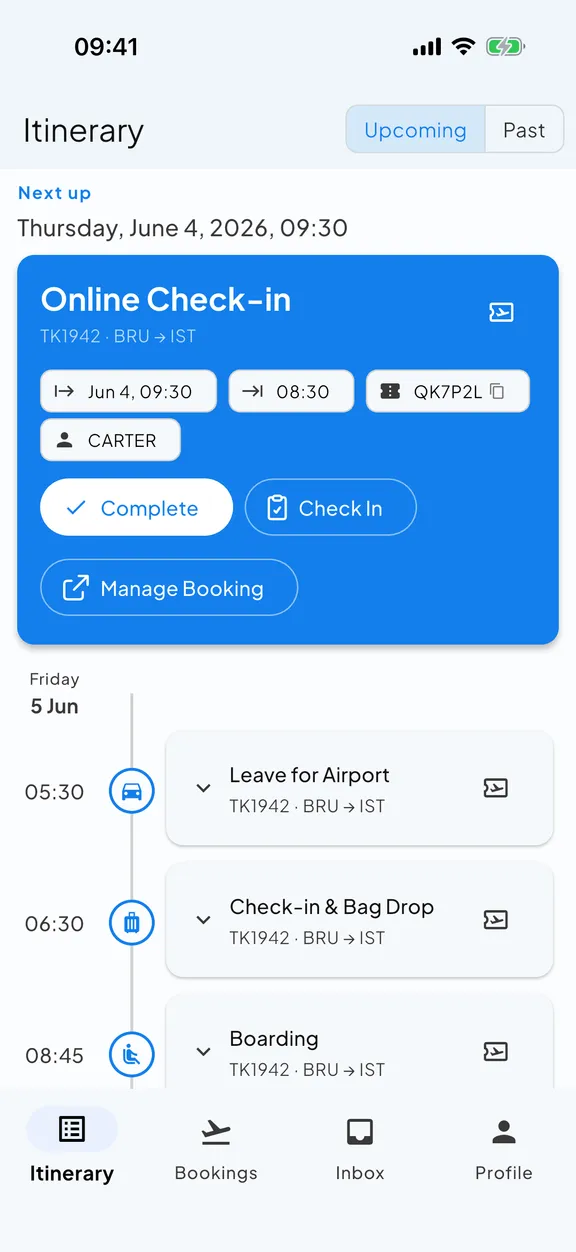
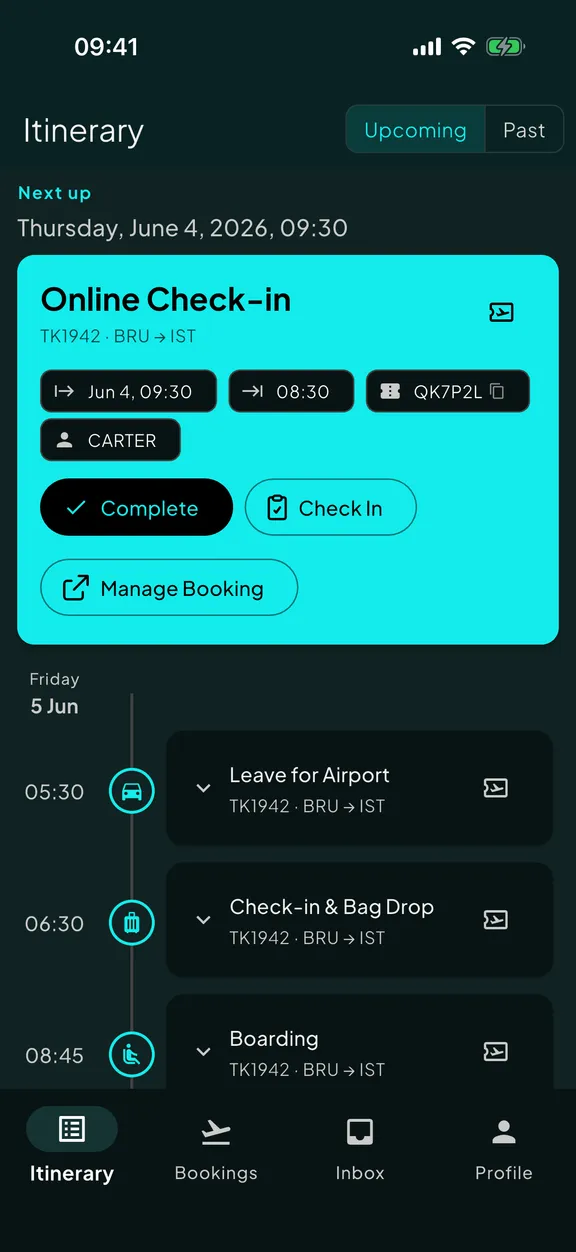
The model is simple on purpose: you forward a booking confirmation, and from there it’s not your job anymore. Skaoot reads it, places it on one timeline in the order things happen, links it to the rest of your trip, keeps it correct when plans change, and surfaces the one detail that matters at the moment it matters: the drive time when you land, the door code on arrival, the gate change the instant it happens. The loops close without you holding them. You can see exactly how that works if you’re curious about the mechanics.
I won’t pretend it does everything yet. Today it fully handles flights, stays, trains, and vehicle rentals, and checks the visa side of every trip, with more booking types on the way. And I won’t pretend an app is the only path to a calmer trip. But the principle underneath it is the thing I actually believe, app or no app: travel feels chaotic when you’re the one holding it all, and it feels calm the moment something trustworthy holds it for you.
Travel was supposed to feel like freedom. It can again, not by caring less, but by carrying less. That’s the whole idea, and it’s what we’re building.
Quick answers
Why does travel feel stressful even when nothing goes wrong?
How do I make travel feel calmer?
Tired of holding your whole trip in your head?
Skaoot turns forwarded booking emails into one calm timeline of flights, stays, and more. It updates itself when plans change. Free for your first 5 bookings.